 CourtHeath Consulting
 CourtHeath Consulting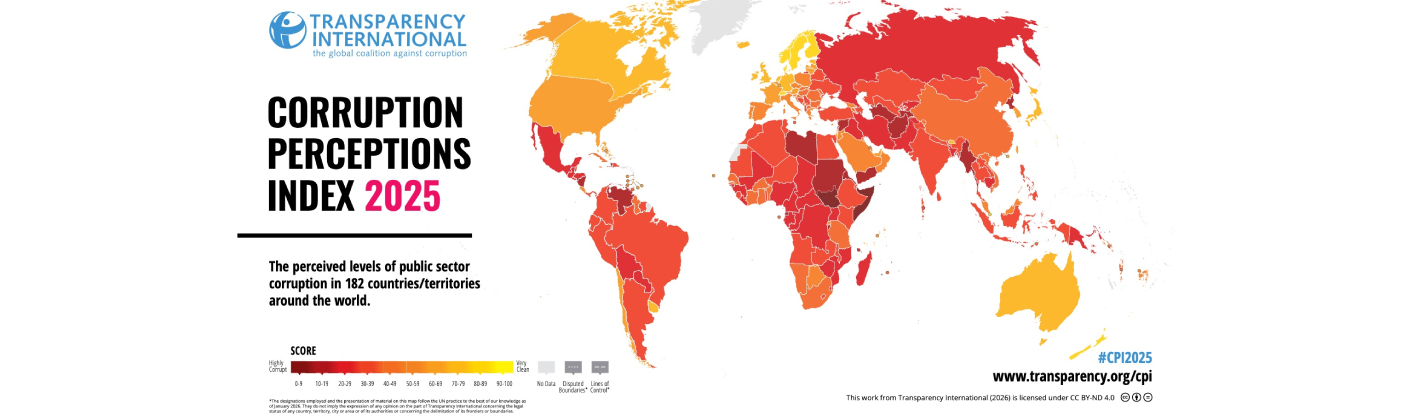
Public sector integrity shapes trust in institutions, economic stability and people’s daily lives. The 2025 Corruption Perceptions Index (CPI) shows that global progress against corruption is uneven and, in many countries and territories, has either stalled or is reversing.
In this blog, we outline what the CPI measures, provide an overview of the key global findings and recommendations for 2025, and then consider Australia’s result within this international context.
The Corruption Perceptions Index
Transparency International’s CPI assesses perceived levels of public sector corruption in 182 countries, drawing on 13 independent data sources and scoring countries on a scale from 0 (highly corrupt) to 100 (very clean). The index reflects expert and business perceptions of integrity in public institutions rather than measuring individual incidents.
Global results in 2025
The 2025 CPI shows a global average score fell to 42 (2024: 43) – the first decline in more than a decade – with 122 countries scoring below 50, signalling serious corruption concerns across most of the world.
Denmark ranked first with a score of 89, while only four other countries achieved a score above 80, down from 12 a decade ago. More than two thirds of countries scored below 50, and those scoring under 25 were largely conflict-affected contexts or highly repressive countries.
The report identifies a concerning trend of declining perceived integrity in several advanced economies, including the United States (64), Canada (75), the United Kingdom (70), France (66), Sweden (80) and New Zealand (81). The weakening of checks and balances, gaps in anti-corruption legislation and reduced enforcement are cited as contributing factors.
The CPI findings reinforce the link between civic freedoms and corruption control. Countries that protect freedoms of expression, association and assembly tend to perform better, while declines in civic space are associated with worsening corruption risks. Since 2012, 36 of the 50 countries with significant CPI declines have also seen civic freedoms reduced.
Corruption’s impacts extend beyond governance systems. It is associated with weakened justice systems, inequality and reduced access to essential services. Since 2012, 150 journalists have been killed while reporting on corruption in non-conflict settings, with more than 90 per cent of these deaths occurring in countries scoring below 50.
Highest scoring countries
- 89 points: Denmark (2024: 90)
- 88: Finland (=: no change)
- 84: Singapore (=)
- 81: New Zealand (83); Norway (=)
- 80: Sweden (=); Switzerland (81)
- 78: Luxembourg (81); Netherlands (=)
- 77: Germany (75), Iceland (=)
- 76: Australia (77); Estonia (=); Hong Kong (74); Ireland (77)
Lowest scoring countries
- 10: Venezuela (=)
- 13: Yemen (=); Libya (=); Eritrea (=)
- 14: Sudan (15); Nicaragua (=)
- 15: Syria (12); North Korea (=); Equatorial Guinea (13)
- 16: Myanmar (=); Haiti (=); Afghanistan 17)
- 17: Turkmenistan (=); Burundi (=)
- 19: Tajikistan (19)
- 20: Democratic Republic of the Congo (=); Comoros (21); Cambodia (21)
Report recommendations
“At a time of climate crisis, instability and polarisation, the world needs accountable leaders and independent institutions to protect the public interest more than ever,” said TI CEO, Maíra Martini.
The 2025 CPI report calls on governments and institutions worldwide to strengthen integrity systems and reinforce accountability through practical reforms, including:
- Ensure independent, transparent and accessible justice institutions
- Tackle undue influence on political decision making
- Give people harmed by corruption access to justice
- Foster civic space and anti-corruption reporting
- Enhance transparency and oversight in public services and public financial management
- Prevent, detect and punish large-scale corruption and illicit financial flows.
Asia-Pacific and Australia in the CPI 2025
Across the Pacific, Transparency International (TI) reports that corruption remains a persistent challenge and argues that governments are not doing enough to meet the region’s anti-corruption commitments under the 2020 Teieniwa Vision. While the CPI results place New Zealand (81) and Australia (76) at the top of the region, TI notes that the long-term trend since 2012 is a steady decline for both countries. It also reports limited score movement over recent years in several Pacific countries including Vanuatu (47), Solomon Islands (44 and Fiji (55), linking this pattern to limited action, weak oversight and concerns around transparency, and governance. To strengthen integrity, TI recommends Australia strengthen protections for whistleblowers through an independent protection authority, strengthen safeguards against undue influence through stricter lobbying regulation, and strengthen the effectiveness of the National Anti-Corruption Commission.
Conclusion
The 2025 CPI findings emphasise the importance of independent justice systems, transparent decision-making, protected civic freedoms and effective oversight. Australia’s score reflects comparatively strong perceived integrity, but the regional and global trends underscore the need for sustained reform and vigilance to maintain public trust and institutional accountability.
Read the 2025 CPI report here.
Resources
- Corruption Perception Index 2025 (Transparency International)
- Corruption Perceptions Index 2025: Pacific Governments falling short on anti-corruption commitments (Transparency International)
***
CourtHeath acknowledges the Traditional Aboriginal Owners of Country throughout Victoria and pays respect to Elders past and present, and to the ongoing living culture of Aboriginal people.
A participant in the UN Global Compact, CourtHeath seeks to raise awareness about the sustainable development goals and the principles of the Global Compact with business and government organisations in Victoria.
***
IMAGE: Transparency International
[category courtheath's blog]
